

“Handwriting is “one of the most visceral means by which human beings leave tracks of their existence” (Nelson et al., 2018).
One of my fondest childhood memories of this time of year is the smell of a brand new pencil case. I can still smell it so clearly. The little thin foam wrapping inside, the brand new pencils, erasers and pencil-sharpeners all sitting neatly inside, untouched. Waiting to make their (literal) mark on the world. I still engage in this ritual every September, and with it still comes pure joy and delight! Nothing signals possibility and hope more than a sharpened pencil and a blank page. The start of a new school year, a new term, a new semester. Handwriting allows for the telling of stories, for the creation of imaged worlds and for experiences to be shared and chronicled.
But how valued is the simple pencil and copybook in today’s society and in today’s schooling, as laptops and iPads slowly but surely, continue to make their way onto school booklists across the country? Does this introduction of technology into our classrooms signal that the end is nigh for handwriting as a skill? Literature in the area contends that handwriting as a skill is in fact, very important indeed – not just as a tool to access society, but for higher cognitive processes involved in reading and writing.
Contribution of Handwriting Skills to School Success
Problems with the mechanical aspects of handwriting can negatively influence the writing and academic performance of students in a numbers of ways in the classroom. Firstly, poor motor control will affect a child’s ability to write legibly and result in incorrect size or placement of letters, inadequate pencil grip and slow handwriting speed. Research indicates that as a consequence of poor legibility, readers may be biased in their evaluation about the ideas and quality of a text and written text may be less accessible to others. Good handwriting is still regarded by teachers as a sign of academic prowess and a less legible version of a paper will be scored lower than a more legible one, according to research.
Secondly, poor motor skills and handwriting skills may impede children’s writing efforts by interfering with other writing processes. The Writer Effect, describes how handwriting expends a significant amount of cognitive resources until it becomes a fluent and automatic skill. Until children can produce letters with reasonable legibility and speed, they spend much of their concentration and energy on letter production, as opposed to the creative processes. Children experiencing fine motor difficulties are often fatigued by handwritten tasks in school and often take longer to complete their work. This means that they are likely to lose some writing ideas, as their handwriting is often not fast enough for them to record all of their ideas.
Finally, the effect of poor fine motor and handwriting skills on academic achievement is highlighted by the significant proportion of the day allocated to fine motor and written tasks in early years’ settings. Most learning activities in the classroom involve motor as well as cognitive components. Children’s self-perception, self-esteem, and motivation are likely to be negatively impacted as a result. Children with strong fine motor skills on the other hand, have been found to demonstrate higher academic achievement, mathematical achievement and earlier development of reading. Research indicates that because handwriting tasks demand integration of the motor and visual processing systems, handwriting fosters children’s early literacy skills. Children showing competency in handwriting skills have more sophisticated letter knowledge, phonological awareness and spelling competence while children’s word writing skills at the end of kindergarten have been used to predict children’s literacy skills, including spelling, reading comprehension and oral reading, by the end of first grade.
A Staged Approach to Using Technology
In light of this research however, it is also important to note that for a number of learners returning to school this September, significant perceptual and motor difficulties will impede on their ability to produce legible script. For these learners, despite considerable intervention efforts, their capacity to write fluently and automatically will inhibit their educational progress, and perhaps even more importantly – their sense of self, and their confidence. This is where technology can play a critical role.
Nonetheless, research indicates that a decision to use technology as a solution for those struggling writers requires much consideration, and that technological interventions should not be used as an immediate and reactionary response. Literature in the area suggests that technology should be used alongside handwriting up until age 8 or 9. This is of course – dependent on individual learner needs. In addition, the use of alternative means of recording communication should be carefully considered and based on detailed, individual profiling of a learner’s areas for development, and areas of strength. It is important to note also, that difficulties a child experiences in relation to handwriting development (perceptual and motor), are likely to persist in the areas of keyboarding or using apps.
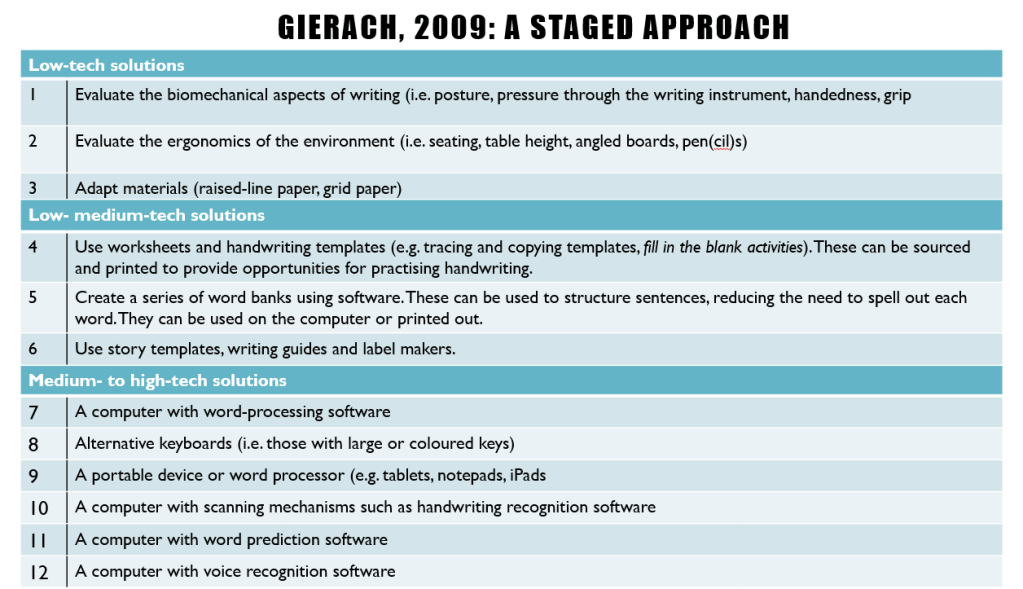
Gierach’s (2009) Staged Approach to the use of technology might prove a useful guide for parents and teachers as embark on our return to school. This framework outlines a number of low-tech and low-medium tech solutions that may just provide enough of a scaffold for struggling writers, before a decision is made to go with a more high-tech solution. It provides a gentle reminder that while technology plays a key and important role in meeting individual learner needs…let’s not be rash in our decision to ditch the humble pencil-case…
Further helpful resources for parents and teachers of struggling writers can be found here:
- https://www.hse.ie/eng/services/list/1/lho/corknorthlee/therapy/paediatric-occupational-therapy/paediatric-occupational-therapy-handwriting-skills.pdf
- https://www.hse.ie/eng/services/list/1/lho/corknorthlee/therapy/paediatric-occupational-therapy/paediatric-occupational-therapy-pre-writing-skills.pdf
- https://www.hse.ie/eng/services/list/1/lho/corknorthlee/therapy/paediatric-occupational-therapy/occupational-therapy-school-resource-pack.pdf
- https://www.hse.ie/eng/services/list/1/lho/cavanmonaghan/therapy-services/older-child-resource-pack.pdf
- https://www.hse.ie/eng/services/list/1/lho/corknorthlee/therapy/paediatric-occupational-therapy/hand-dominance.pdf
- https://enableireland.ie/sites/default/files/publication/Handwriting%20Booklet%20final.pdf
- https://enableireland.ie/handwriting-skills-part-1-6-typical-development-difficulties
- https://www.dyspraxia.ie/Assistive-Technology
- https://www.sess.ie/categories/specific-learning-disabilities/dysgraphia/tips-learning-and-teaching
- https://curriculumonline.ie/getmedia/23a877d2-3199-4086-b150-fd441697874b/WRITING_Language_of_handwriting.pdf?ext=.pdf
- https://curriculumonline.ie/getmedia/db269a17-5ee1-4c7c-a949-b52fe8146a7f/WRITING_Patterns-for-Handwriting-Writing.pdf?ext=.pdf
 Sinéad McCAULEY LAMBE
Leave a comment