
Last Thursday night, I went to see (or perhaps ‘experience’ would be a more apt term), Michael Keegan-Dolan’s Mám, at the Bord Gáis Theatre. I had been hoping for a chance to see Mám since watching The Dance – a short-film by Pat Collins – documenting the creative process behind this remarkable dance production. And it did not disappoint. In fact, it surpassed all expectations.
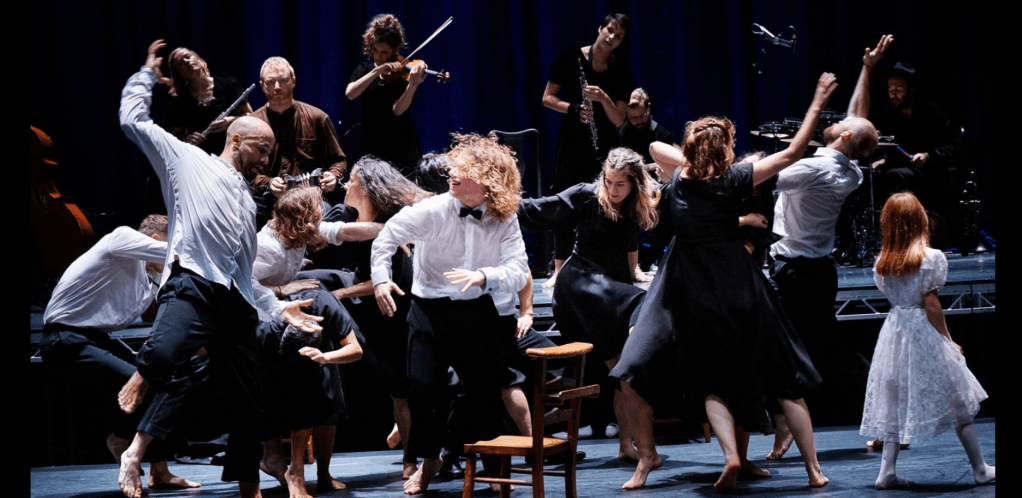
Image: https://teacdamsa.com/production/mam/
It is almost impossible to describe Mám, suffice to say it was a mesmerising, almost hypnotic feast for the senses from start to finish. Centred around the music of Cormac Begley and Stargaze, Cormac himself described the show as making physical his music. Any further attempt by me to put the experience into words would be very difficult. The purpose of this reflection rather, is to wonder about an insight that Michael generously offered post-show, during a question and answer session with the audience.
When asked about the process that led to the creation of Mám, Michael spoke about repetition, endless hours of practice, painstaking refinement and complete immersion in the process. He then went on to share an anecdote about a lesson he had learned from the actor Mikel Murfi (who he noted studied with Jacques le Coq in Paris), that struck a particular chord. He told the audience of how once, after he had danced, Mikel told him to do it again, but this time to ‘do it worse’. ‘Do it worse?’ Michael wondered aloud. ‘But I am f’in brilliant!’ he quipped. ‘You want me to be more sh**?’. ‘Yes, be more sh**’, Mikel confirmed. The audience laughed. ‘How very liberating’, Michael concluded with a beaming smile. To be told to be worse. To be more sh**.
It was in this moment, that I was reminded of the ‘Do Better’ slogan that is so often used today, particularly in the world of social media (#dobetter), and more recently – in the world of education. And while we have heard Michael’s ‘do worse’ message before, albeit in many different guises (it is in the getting things wrong that the real learning happens), why and how then, I found myself wondering, has this ‘Do Better’ motto found its way into the field of education?
Education is a field where surely, making mistakes and navigating a way through messy and complex processes should be front and centre of all that we do. A field where answers and solutions elude us often, but where we continue to try to make meaning of our experiences on a daily basis. To sometimes ‘do worse’ would enable us as teachers to immerse ourselves fully in the creative art of teaching and to step back from ‘do better’ – the relentless pursuit of a programme, or a resource that will lead us to perfect pedagogy. To ‘do worse’ would allow us grapple with failure, to dig deep and to find ways to reach learners in ways that are not rational, or easily explained in a book or through a course.
These thoughts led me back to The Dance – the aforementioned short-film that documents the process from which Mám emerged. While watching The Dance, I was struck by many things, but in particular an encounter between Michael and one of the dancers played on my mind. As the group sat in a reflective circle, Michael gently invited contributions. Out of the silence, one person spoke; a dancer about her struggle trying not to give Michael what she thought he might ‘want’. The inner tussle she experienced between allowing the movement to emerge from an authentic, organic place, rather than to try to ‘please’ the director. Michael responded by acknowledging this dilemma, and spoke about his own struggle with keeping his agenda out of the process. He had to work hard not to ‘want’ anything from the dancers. Not to have a prescribed vision of what Mám would look like at the end of the 8-week immersive process. To embrace and to trust the messy complexity of the creative process, and to allow the meaning and the learning to emerge. A true attempt at sense making.
And with that, I was immediately transported to the classroom, to the preschool room, to the lecture hall.
The dancer for me represented both a young child and a third-level student, fearful of making a mistake and trying hard to always please the ‘teacher’. The director represented the teacher, the lecturer, the educator, who so very much wants to respond to the individual child, but who is bound by standards and objectives. It made me wonder about the possibilities for teaching and learning if we could somehow remove the ‘do better’ barrier that makes students want only to give the ‘correct’ answer. What rich meaning making opportunities might lie in wait if we could immerse ourselves fully in a complex, fraught and messy teaching and learning process like that from which a masterpiece like Mám emerged?
Agenda is this case, is not be confused with the notion of explicit teaching. Nor should it be confused with low expectations, or the abandonment of the entire curriculum and all that it entails. After reflecting on Mám and The Dance, I think about agenda in terms of being able to park the idea that the way I teach is the way that the students in my class should learn. I think about it as acknowledging what the learner has to bring to the process. Responsive and inclusive teaching in its truest form. I want to be able to be truly open to how the child learns, how they interpret, how they make-meaning of their experiences – no matter how messy or ‘worse’ that it looks. I want them to find meaning in the world around them not to please me – but rather to free themselves.
The goal of education is not perfection. It is more one of liberation, as offered by Freire. And as Michael so simply yet so powerfully stated, to be allowed to ‘do worse’ is indeed liberating.
 Sinéad McCAULEY LAMBE
Leave a comment