

Over the past weeks, my students and I explored the topic of behaviours that we find challenging in our classrooms. I love talking, thinking and reading about behaviour, and I loved trying out different approaches to promoting positive behaviour when I was in the classroom.
While sifting through materials and resources that might be useful for the students, I came across the ‘Catch them being Good’ advice sheet from the SESS. The ‘Catch them being Good’ strategy is one that will be familiar to most teachers, and one that I firmly believe in. It is based on the principle that positivity works, and that negativity doesn’t. Instead of taking a deficit approach to behaviour management and pointing out what the child is doing wrong, the ‘Catch them being Good’ strategy proposes that we draw attention to what the child is doing well.
As I described this approach to the students, it seemed like a very obvious solution. Not at all ground-breaking. Simple. We all know this – praise works. But in reality, it is not simple at all. To catch a child being ‘good’ is a very skillful and considered approach that involves truly noticing the efforts of each child. It involves noticing the child, full stop.
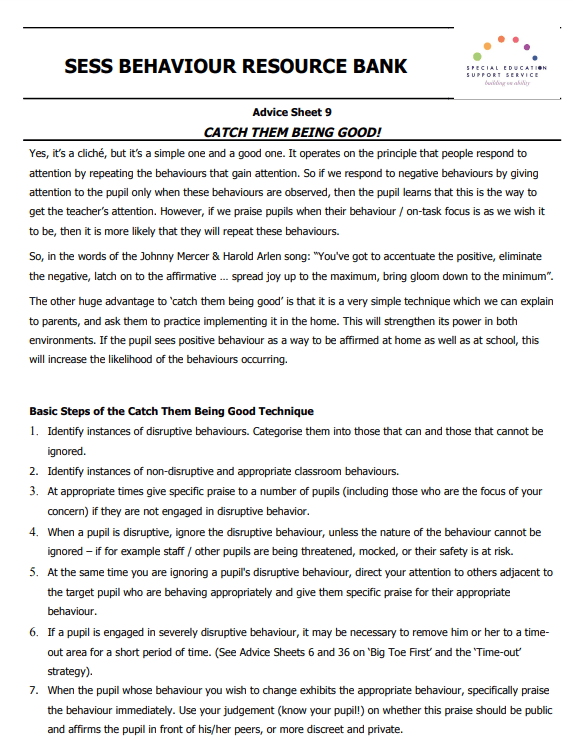
I used that word noticing with the students, and it reminded me of just how difficult it is to notice things when we are distracted and busy and stressed. We might think we are noticing them, and that we are using the ‘Catch them being Good’ strategy effectively – ‘well done’, ‘you’re great’, ‘very good’, ‘good job’. But real noticing involves being fully present to the child in that moment, and communicating to them that what is most important.
I was lucky to be taught the art of noticing by my principal early on in my teaching career. I can clearly recall him standing at the front door of the school in the morning, welcoming each boy as they arrived. He noticed each and every one of them that came through the door– ‘Good morning!’ ‘I love the way you have your jumper on you today!’, ‘I love the way you smiled at me when you came in’ ‘I love the way you said goodbye to your mam!’. Noticing. All the time noticing.
During the morning breakfast club, he would arrive down from his office, every morning at the same time, and take a seat on the benches alongside the boys. ‘How are you today?’ ‘What’s your news?’ ‘What did you have for breakfast?’. Noticing. Seeing them all.
He carried this arduous task of noticing lightly, so lightly in fact, that one might not even notice he was doing it.
But one time that we all as staff did notice, was at Christmas time when we each received a handwritten card. Each staff members card contained precious and valued ‘noticing’s. Things that we had done well, extra efforts that were made and noticed and written down. No generic ‘thank you, you’re great’. A line or two that made you feel truly seen, valued, acknowledged and affirmed. We joked as colleagues about how much we valued those cards. About how they sustained our work in what were oftentimes overwhelmingly challenging circumstances. We laughed at the idea of adult men and women showing their cards proudly to parents when we went back home for the holidays.
But there is a lesson in all of that. The power of feeling noticed. Not tokenistic praise. But truly noticed for who we are and what we are trying to achieve. How often do we hear the phrase ‘pay them no notice, they’re just looking for attention’? We all look for and need attention. We are all human – children and adults alike. I wondered about this with the students. What does a child cherish more – a sticker or feeling noticed? A ‘student of the week’ trophy at the end of the week because it was their turn or feeling noticed? An ice-cream party on a Friday or feeling noticed? Which one has a greater, long-lasting impact on their sense of self and their subsequent behaviour? Because ultimately the two cannot be separated.
The answer to positive behaviour therefore, lies not in the aesthetically pleasing reward chart, but right in front of us. In each and every child, if we can pause for long enough to notice it.
 Sinéad McCAULEY LAMBE
Leave a comment