
https://www.youtube.com/channel/UCkkEjgdlx5JrQ4NO38oxdNw
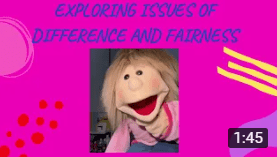
This week’s reflection takes place over on the Molly’s Musings YouTube Channel. Watch as Molly describes her bad day at school, stemming from her feeling that her teacher is being unfair.
Grappling with the concept of fairness (or unfairness), consumes much of children’s time and energy throughout the school day. Many teachers will be familiar with this, and will be able to recall countless instances of explaining to young children why a particular decision is either fair or unfair.
Children will naturally question fairness, and they are naturally inquisitive and curious. Unknowingly, and often as a consequence of time constraints, our response as teachers is to quash those dispositions – particularly when it comes to children’s questions around difference.
When a question relating to difference emerges, we immediately want to make sure that everyone is okay, and that nobody’s feelings are hurt. We are programmed to think that we shouldn’t draw attention to difference – avoid, distract, move on. More than anything, we don’t want to embarrass anybody or make somebody feel bad. We have a bank of ‘get-out-of-jail’ phrases for when we are faced with a tricky question – ‘we’re not talking about that now’ , ‘we don’t say things like that’ ‘we only say nice things’.
But perhaps, in our efforts to protect those children that we consider most vulnerable, we miss a valuable window of opportunity to explore important issues relating to difference and fairness that might serve those children far better.
In ‘shushing’ children when they ask the questions that we often fear – ‘why does he get a special seat?’ ‘why do they get to go out with that teacher to play?’ ‘why do they get a different lunch?’ ‘why can’t she talk?’’, we move further away from creating a truly inclusive environment. We also run the risk of communicating inaccurate messages to children in our bid to distract them from everyday issues of difference.
My sister showed the video of Molly to her daughter this evening- she is 5 years of age and is just coming to the end of her first month in junior infants. Her mam asked her – why do you think that the boy had a different seat? The 5-year old thought about it for a moment, before responding ‘mmm…I think because he was really, really good’.
Maybe this was a well-meaning response she’s been given by a teacher to explain differentiation in the past. Or perhaps she has already learned the game of positive reinforcement and reward in her four short weeks in school, and this is the most feasible explanation that springs to mind. Either way, what messages is she receiving in this case? That the boy got the ‘special’ seat because he is good. That means that by default, that she (or Molly with whom she was feeling very sad for) is not.
My sister probed a little further…why else might the boy have had a special seat? The 5-year old thought about it some more. ‘Well…’ she said. ‘Sometimes people find it really, really, really hard to sit in their chairs, and my teacher gives them a cushion’. ‘Oh, and why does she do that?’ my sister asked. ‘To make them comfortable to do their work’ the 5-year old responded. ‘So do you think that maybe it was the same for the boy in the story? That he needed a special seat to learn better?’ . ‘Yes’ the 5-year old stated confidently, and with a definite hint of relief in her voice. That made sense to her. That meant she wasn’t bad if she didn’t have one. That meant that it was okay that boy needed extra help. That meant that it wasn’t unfair anymore.
Let us not forget, that children are naturally compassionate, that they are naturally good, and kind and empathic. And they are far more capable of accepting and understanding difference than we often give them credit for.
Molly’s story invites us to think about grabbing these naturally occurring moments of questioning to explore issues of difference and fairness in the classroom. Instead of avoiding talking about difference, the use of puppets and story can act as a powerful tool to help children develop empathy for others, as well as engaging them in meaningful problem-solving and enabling them to draw their own conclusions.
Following on from Molly’s description of what happened, we could ask the children to wonder about why somebody might need alternative seating, or why it might be helpful to them. The story presents an opportunity to prompt children to reflect on all the different things they need extra help with and how that looks different for everyone. The story can be adapted or changed depending on the context of your classroom, and the issues at hand. Using the puppet to describe the experience of a child with special educational needs, or to describe the perspective of another child in the class creates a safe distance between the children and the issue being explored.
Using puppets to express complex feelings and thoughts can help to normalise difference in all of its forms, and to ensure that concepts of difference and sameness become part of children’s everyday, lived experiences and dialogue. Instead of telling children how they should feel about difference, let’s give them a chance to process those feelings and to work it out for themselves.
 Sinéad McCAULEY LAMBE
Leave a comment