
Schools are systems. They depend on order, structure, procedures and organisation. And so as teachers, order, structure, procedures and organisation become central to all that we do. Classroom organisation is a topic that is widely researched, blogged about, taught, assessed and reflected upon by most teachers. And today, with the help of social media and with easy access to online resources, classroom organisation appears to be even more to the forefront of what we do.
‘Really Useful’ rainbow stacking drawers, colour coded baskets and boxes, stickers, labels, post-its and pretty pastels. I have bought them all!

Alongside those beautiful, Pinterest worthy resources are the slightly less visible facets of classroom organisation – the transition games and songs, the teaching of clear rituals and routines, and the signs and symbols dotted around the classroom and whole school environment – all with the same goal: to ensure that children feel safe and secure in a predictable environment and to increase instructional time and the quality of teaching and learning in our classrooms. Classroom organisation is a positive thing – it helps children to learn better. That is what I have always believed, in any case.
And so, it was only this week, during a conversation with a group of post-primary teachers about children’s motor development, did it strike me that classroom organisation may also act as a barrier to children’s learning and development. We were discussing spatial awareness as a key component of motor development – children’s ability to understand where their bodies are in space. Spatial awareness is a key foundation upon which all other components of gross motor development depend.
I used the example of lining up in the classroom, and how difficult it is for young children to line up without bumping into each other, pushing and shoving or ‘falling out’ of the line. I explained that in my experience, it is so challenging for children to learn how to line up, that as infant teachers we use a nifty classroom organisation trick to ‘solve this problem’. We put down markers on the floor – floor spots or masking tape that indicate to the children where they should stand.
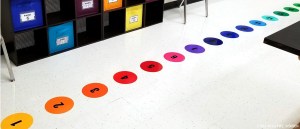
As I described the strategy, and heard it out loud, I realised that in essence, all that we are doing in this case – is ‘putting a bit of Vaseline on it’. Sticking a plaster on it. We have effectively created a method of organisation, but what have we achieved in terms of actually meeting the children’s developmental needs? What have we done in terms of getting to the root of the issue? One of the teachers in the group pointed this out – ‘ah ha’! Now it makes sense why none of our students can line up in post-primary school – why they have no awareness of each other’s space! We laughed about it in that moment, because in that moment the practice of putting down markers on the floor instead of actually teaching spatial awareness seemed pretty laughable.

It seems obvious now, but it isn’t at the time. Or at least it wasn’t for me. Because when we are faced with a classroom of such diverse and complex learning needs, often classroom organisation and having effective systems are all that we can do to ‘survive’. But of course on reflection, children are never going to learn anything about body awareness or spatial awareness by simply employing the ‘markers on the floor’ method of classroom organisation. All that we have achieved is a system that works in this context. Take away the spots…and well, we have a situation that probably looks similar to the badly socially distanced queues we all experienced in Dunnes, and Tesco and Aldi and Lidl during those dark pandemic days. Those numerous days when we wondered irritably why the person in front of us or behind us or beside us didn’t seem to be able to grasp the idea of leaving a 2-meter space.
In saying all of this, it is important to note, that spatial awareness is no doubt being addressed by teachers elsewhere – most likely as part of the PE curriculum. But even if this is the case, and children are engaging in spatial awareness activities as part of their physical education, surely we need to make that learning meaningful so that children can use the skills of spatial awareness as part of their daily occupations…like lining up. Which, let’s face it…they are going to have to put up with a lot of over their school years.
It is worth perhaps reflecting on then, how many of our ‘classroom organisation’ strategies merely serve as a handy tool to ‘put a bit of Vaseline on it’, and how many actually tend to the learning and development of life-long skills that children will need to successfully navigate the rich and complex world outside of the classroom system.
 Sinéad McCAULEY LAMBE
Leave a comment