
I recall vividly the moment in my teaching career when I was catapulted from the known safety of mainstream classroom, into the vast unknowns of the special education setting. A moment at the time that felt chaotic, messy and daunting, but which I now recognise as a pivotal moment in my professional and personal development – a moment that pushed me (at times reluctantly) into a space of deep reflection and searching.
All of a sudden, the things that ‘worked’, no longer ‘worked’. The learning objectives that I had become familiar with for each subject area were no longer a fit for the children that I was teaching. The curricular areas, strands and strand units became rather irrelevant in light of the complex needs I was presented with, and the lovely resources and activity banks that I had built up became sadly defunct. I felt like I had no solid ground beneath me, nowhere to hang my hat, and I didn’t really know what to do. A feeling of failure followed me out the door daily, as I lamented the days when I could go home happy and satisfied that I had ticked off my daily timetable, my lessons taught and my objectives met.
And so, I spent my evenings trawling Google, Pinterest, TPT, various SEN related blogs and I sought support from my experienced and wise colleagues. I relied heavily on the NEPS Resource Pack and the Continuum of Support which provided a very helpful framework around which to build my practice. With each passing week, I cautiously began to identify methods and ways of teaching and learning that appeared to be effective – moments when children were engaged, happy and learning. Most of those methods however, were completely at odds with what I had previously associated with ‘good’ teaching. In fact, they didn’t ‘look’ like teaching at all! All of my learned ideas of what teaching ‘looked’ like were being shaken up and thrown about, and I was finding it hard to stand over my newly discovered ways of teaching, without the language or a framework to describe it.
My attention turned to the learning process – my interactions and relationships with each child, rather than the learning outcomes. And the concept of being truly ‘present’ in the moment, and following the child’s lead become absolutely central to my practice. I had to let go of the idea of ‘having a plan’ – which sounds easier than it is, having spent many years placing a disproportionate amount of significance on planning. My practice became much more about grabbing those ‘teachable moments’ when they presented themselves, and becoming a skilled facilitator of learning, who was able to be responsive to individual needs at individual moments in time. It is a hugely complex, skilled and demanding task to ‘teach’ in this way, and one that I felt like I was learning from scratch. It requires us to essentially unlearn much of what we have experienced ourselves in relation to the education system, and to take a step back and notice what it is that the child really needs.
Despite not being able to find the words to describe what I believed was good practice, what was clear to me was that in order to move forward in my teaching with children with additional needs, and to make progress, I first had to go back. The more that I engaged with children with diverse learning needs, the more aware I became of their developmental stage. The less focused I became on subject areas and objectives, the more I was drawn to the developmental needs of each child–namely their emotional and social well-being, their communication, their thinking and their sense of identity and belonging in the classroom and school. Sound familiar?
It was only when I moved into initial teacher education and began teaching on the B.Sc. in Early Childhood Education that the parallels began to reveal themselves. As I immersed myself in the language of Early Childhood Education – child-led, playful, responsive, relational, facilitator, dispositions, environment, diversity, relationships and development – I came to realise that what I had been trying to articulate in relation to my SEN teaching, were the key principles of Early Childhood Education. There was a language and indeed, a framework, to describe what I was trying to do.
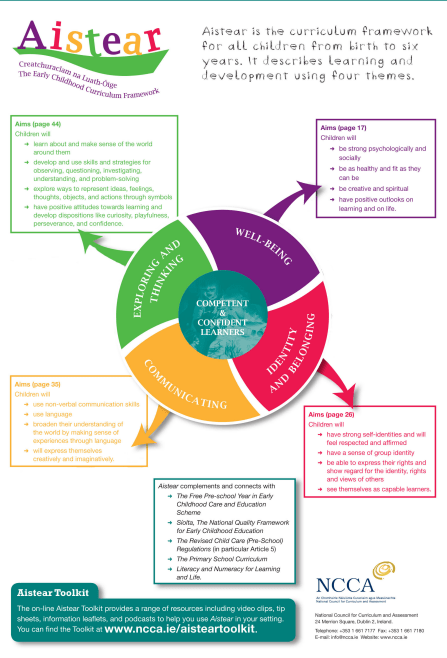
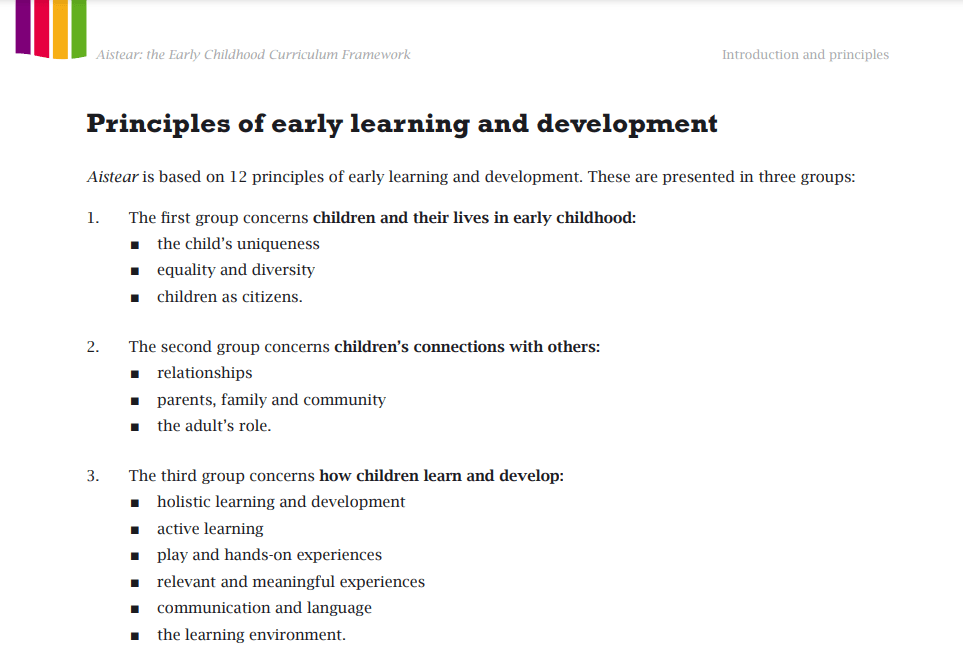
Aistear – the Early Childhood Curriculum Framework for children from birth – 6 years in Ireland outlines those key principles clearly, providing a broad and applicable framework to scaffold children’s learning and development. Having grappled with finding a framework to fit what I was trying to implement in practice, I would argue that the Aistear Framework is not only suitable for children from birth – 6 years, but that it can be adapted for use for learners of all ages with diverse learning needs. The 12 principles lend themselves so well to teaching children with additional learning needs – acknowledging the child’s uniqueness, equality and diversity, the centrality of relationships and focusing very much on playful, hands-on experiences, the importance of the learning environment, and holistic learning and development.
The four themes that underpin the framework – Well-being, Communication, Exploring and Thinking and Identity and Belonging, and the associated aims and learning goals provide exactly what I had been searching for! The themes name each of the areas of development that my focus had been drawn to – and within those areas, aims and learning goals that are broad enough for each teacher to interpret depending on the child’s individual profile, but specific enough to enable that teacher to articulate what they are doing in their practice. This framework makes space for professional judgement to be employed, for a variety of contexts to be included, and for a diverse range of learning and developmental needs to be addressed.
On reflection of my own time teaching in children with additional learning needs, I can see now how I could use the Aistear Framework effectively to put language on my practice and my planning, to communicate and collaborate with parents effectively, and to be able to maintain, to articulate and to justify with confidence, my commitment to a child-led, playful and responsive approach to meeting the needs of diverse learners.
 Sinéad McCAULEY LAMBE
Leave a comment